Resources › Test descriptions › WRAML-3
WRAML-3 in plain English.
Wide Range Assessment of Memory and Learning, Third Edition. Memory and learning scores, including from the hand-scored record form.
What it measures
The WRAML-3 looks at how well a student learns and remembers what they see and what they hear, how well they hold attention on a task, and how well they keep information in mind while using it. It checks memory right away and again after a delay.
Who it is for
Evaluators looking into memory, learning and attention concerns, often when a student seems to forget directions, miss what was taught, or learn new material slowly.
Scores it reports
- Index standard scores (average 100)
- Subtest scaled scores (average 10; most students score between 7 and 13)
- Learning trial scores for the graph (kept for the chart, never sent to the sheet)
- Percentiles and descriptors, supplied by AUTOMATA's score sheet
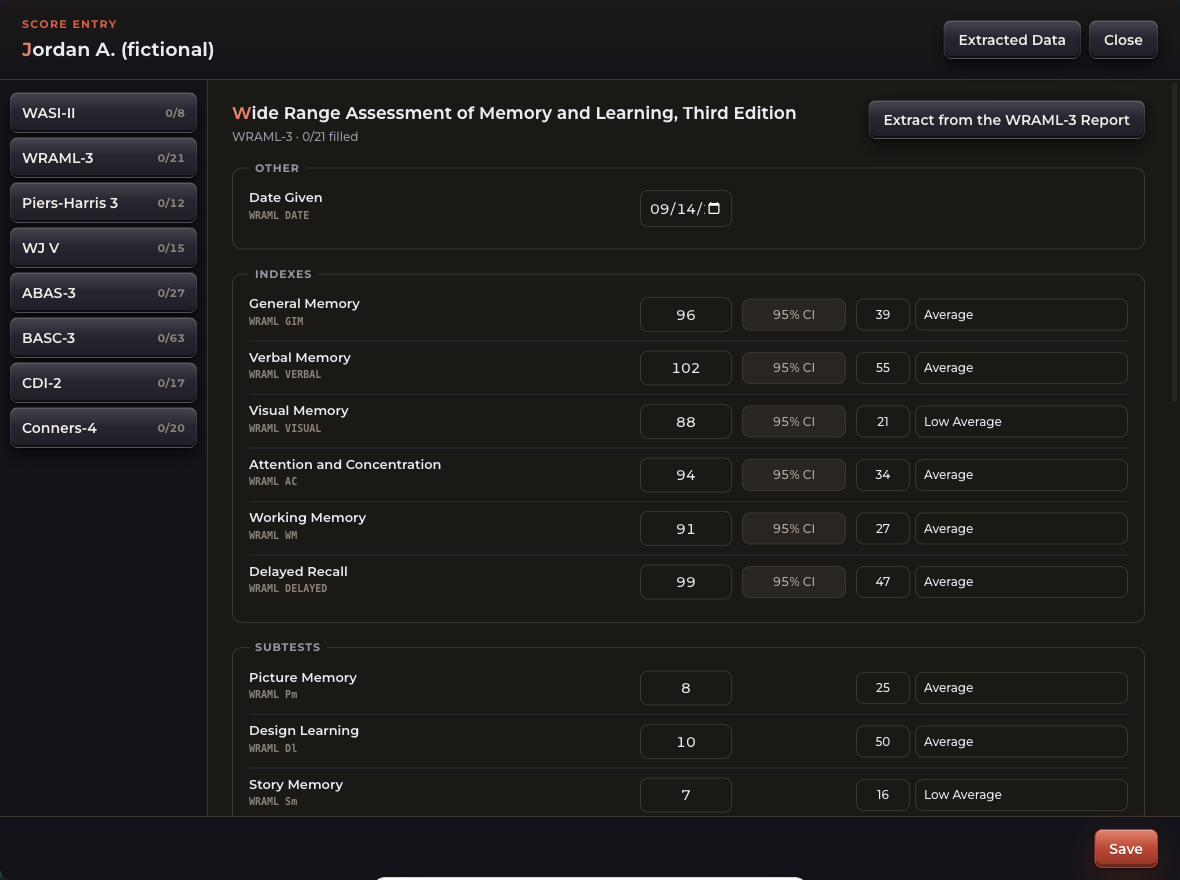
What the score card looks like
How AUTOMATA reads it
- Indexes AUTOMATA reads: General Memory, Verbal Memory, Visual Memory, Attention and Concentration, Working Memory, Delayed Recall.
- Subtests AUTOMATA reads: Picture Memory, Design Learning, Story Memory, Verbal Learning, Finger Windows, Number-Letter.
- Reads the report and the record form by where each number sits against the printed row and column labels. A blank subtest cannot borrow the next row's score.
- Low-confidence digits are left out instead of guessed.
- Reads the printed score report (PDF text layer, or a photo or scan of that printout).
- Checks the student name and birth date on the page against the case before anything is filled in.
- Leaves a box blank when a number cannot be read cleanly. It never guesses.
- Marks every number it read in green so you can check it against the page; a number you type over turns back into a typed score.
What stays with the psychologist
The psychologist reviews and approves every score. Nothing is written into a report until you approve it.
In plain English for families
This test shows how a student learns and remembers new information, both what they see and what they hear. It helps explain why some students need directions repeated or extra practice.
Questions
Does it make the memory graph?
Yes. Learning trials feed the chart in the report; they never go to the score sheet.
Can it read a scan of the record form?
Yes. A scan or photo is read by position. Anything not clearly in one row and column is left blank.
Who checks the numbers?
You do. Green numbers are machine-read and should be checked against the page.
Related tests
Every new AUTOMATA user gets a free 1-week trial, no payment details.
Founding tester spots: 10 users get 60 days free, unlimited reports, no card. Just tell Dr. Valentine what works.
Start your free trialApply for a founding spotSee a sample reportThis page is a general summary for families and practitioners, not a substitute for the publisher's manual. Test names are trademarks of their publishers. AUTOMATA is not affiliated with or endorsed by any test publisher. No test items, stimuli or scoring keys appear on this page.