Resources › Test descriptions › WASI-II
WASI-II in plain English.
Wechsler Abbreviated Scale of Intelligence, Second Edition. A short estimate of thinking ability, from the hand-scored form or a typed report.
What it measures
The WASI-II is a short estimate of thinking and reasoning ability. It uses four subtests: Vocabulary and Similarities (word knowledge and verbal reasoning), and Block Design and Matrix Reasoning (solving puzzles with shapes and patterns). A two-subtest form is also published.
Who it is for
Evaluators who need a quick estimate of cognitive ability, such as at a re-evaluation or as a screen. It does not replace a full cognitive battery.
Scores it reports
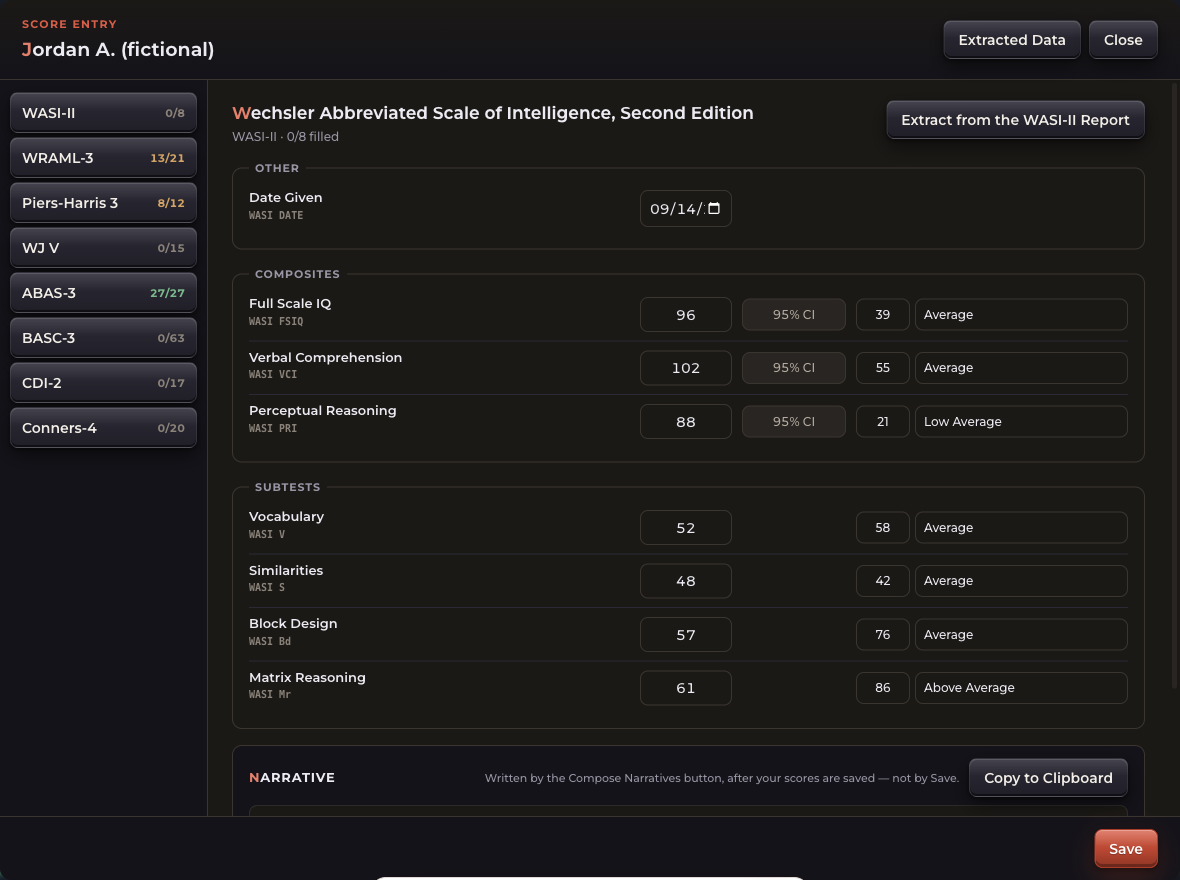
- Composite standard scores: Full Scale IQ, Verbal Comprehension, Perceptual Reasoning (average 100)
- Subtest T-scores (average 50)
- 95% confidence band
- Percentiles and descriptors from AUTOMATA's score sheet
What the score card looks like
How AUTOMATA reads it
- Reads the hand-scored record form (a scan or photo) by where each handwritten number sits against the printed row and column labels.
- Also reads a typed score report.
- A subtest T-score that is written twice on the form is kept when the copies agree. If it cannot be read cleanly it is left blank, or, in one narrow case, rebuilt from the examiner's own written sum and flagged to check on the page.
- A confidence interval that does not contain its own score is dropped.
- Checks the student name and birth date on the page against the case before anything is filled in.
- Leaves a box blank when a number cannot be read cleanly. It never guesses.
- Marks every number it read in green so you can check it against the page; a number you type over turns back into a typed score.
What stays with the psychologist
The psychologist reviews and approves every score. Nothing is written into a report until you approve it.
In plain English for families
This is a brief look at thinking and reasoning skills, using words and puzzles. It gives a general idea. It is not a full picture of what a student can do.
Questions
Can it read my handwritten record form?
Yes, from a scan or photo. Numbers that are not clearly placed are left blank.
Which scores does it read?
Full Scale IQ, Verbal Comprehension and Perceptual Reasoning, plus the four subtest T-scores.
Will it guess a missing score?
No. At most it flags a sum-based rebuild for you to check.
Related tests
Every new AUTOMATA user gets a free 1-week trial, no payment details.
Founding tester spots: 10 users get 60 days free, unlimited reports, no card. Just tell Dr. Valentine what works.
Start your free trialApply for a founding spotSee a sample reportThis page is a general summary for families and practitioners, not a substitute for the publisher's manual. Test names are trademarks of their publishers. AUTOMATA is not affiliated with or endorsed by any test publisher. No test items, stimuli or scoring keys appear on this page.