Resources › Test descriptions › ABAS-3
ABAS-3 in plain English.
Adaptive Behavior Assessment System, Third Edition. Everyday skills, with parent and teacher ratings kept separate, never averaged.
What it measures
The ABAS-3 describes the everyday skills a student uses to get through the day: communicating, using the community, doing school-type tasks, taking care of themselves, handling health and safety, playing and relaxing, and getting along with others. Skills are grouped into three areas: Conceptual, Social and Practical.
Who it is for
Evaluators looking at adaptive functioning, which matters for intellectual disability questions and for planning supports in daily life.
Scores it reports
- Composite standard scores: General Adaptive Composite, Conceptual, Social, Practical (average 100)
- Skill area scaled scores (average 10)
- 95% confidence band as printed
- Percentiles and descriptors from AUTOMATA's score sheet
What the score card looks like
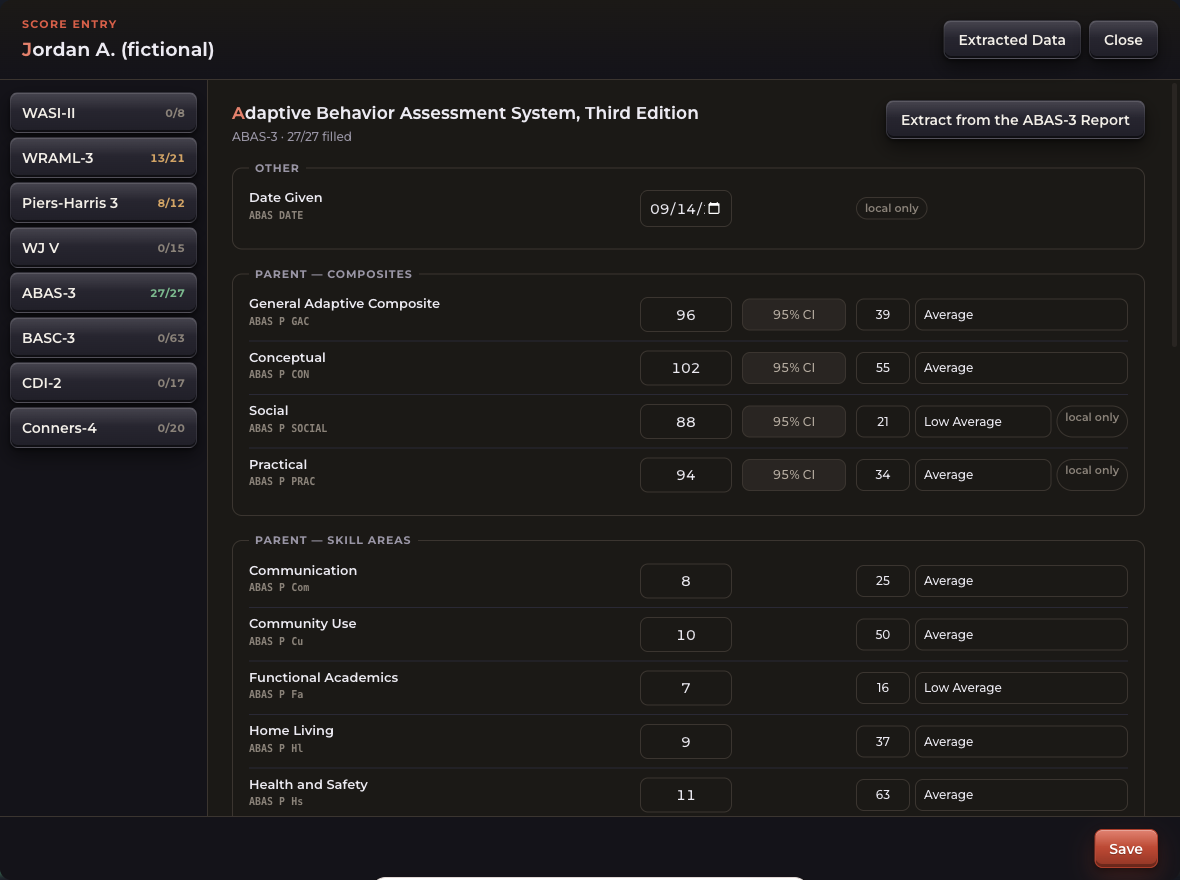
How AUTOMATA reads it
- Parent and Teacher forms are kept apart as two sets of scores. They are never averaged.
- Skill areas AUTOMATA reads: Communication, Community Use, Functional Academics, Home Living, Health and Safety, Leisure, Self-Care, Self-Direction, Social.
- School-age ABAS-3 has no Motor score and AUTOMATA invents no Work score.
- Records who completed the form when the page names the rater.
- A rating form with unscored item bubbles is refused. AUTOMATA needs the printed score report.
- Reads the printed score report (PDF text layer, or a photo or scan of that printout).
- Checks the student name and birth date on the page against the case before anything is filled in.
- Leaves a box blank when a number cannot be read cleanly. It never guesses.
- Marks every number it read in green so you can check it against the page; a number you type over turns back into a typed score.
What stays with the psychologist
The psychologist reviews and approves every score. Nothing is written into a report until you approve it.
In plain English for families
This describes everyday skills, like communicating, caring for oneself and getting along with others. Parents and teachers each rate what they see, and the two views can differ, which is useful.
Questions
Why not average parent and teacher?
Each sees the student in a different place. AUTOMATA reports both and leaves the comparison to you.
Does it read the item-level rating form?
No. It reads the printed score report.
Does it cover the adult form?
The app is set up for the school-age parent and teacher forms.
Related tests
Every new AUTOMATA user gets a free 1-week trial, no payment details.
Founding tester spots: 10 users get 60 days free, unlimited reports, no card. Just tell Dr. Valentine what works.
Start your free trialApply for a founding spotSee a sample reportThis page is a general summary for families and practitioners, not a substitute for the publisher's manual. Test names are trademarks of their publishers. AUTOMATA is not affiliated with or endorsed by any test publisher. No test items, stimuli or scoring keys appear on this page.