Resources › Test descriptions › Piers-Harris 3
Piers-Harris 3 in plain English.
Piers-Harris Self-Concept Scale, Third Edition. A student's own view of themselves, read into a clear scale summary.
What it measures
The Piers-Harris 3 is a self-report. The student answers questions about how they see themselves: how they behave, how anxious they feel, how happy they are, how they feel about school and thinking skills, about their looks, and about fitting in with others. It gives an overall score and six area scores, plus two checks on whether the answers can be trusted.
Who it is for
Evaluators who want the student's own voice in a social-emotional evaluation, as a companion to parent and teacher rating scales.
Scores it reports
- T-scores (average 50; most students score between 40 and 60)
- Total Score plus six domain scores
- Two validity scores: Inconsistent Responding and Response Bias
- Highest and lowest scale, noted for the narrative
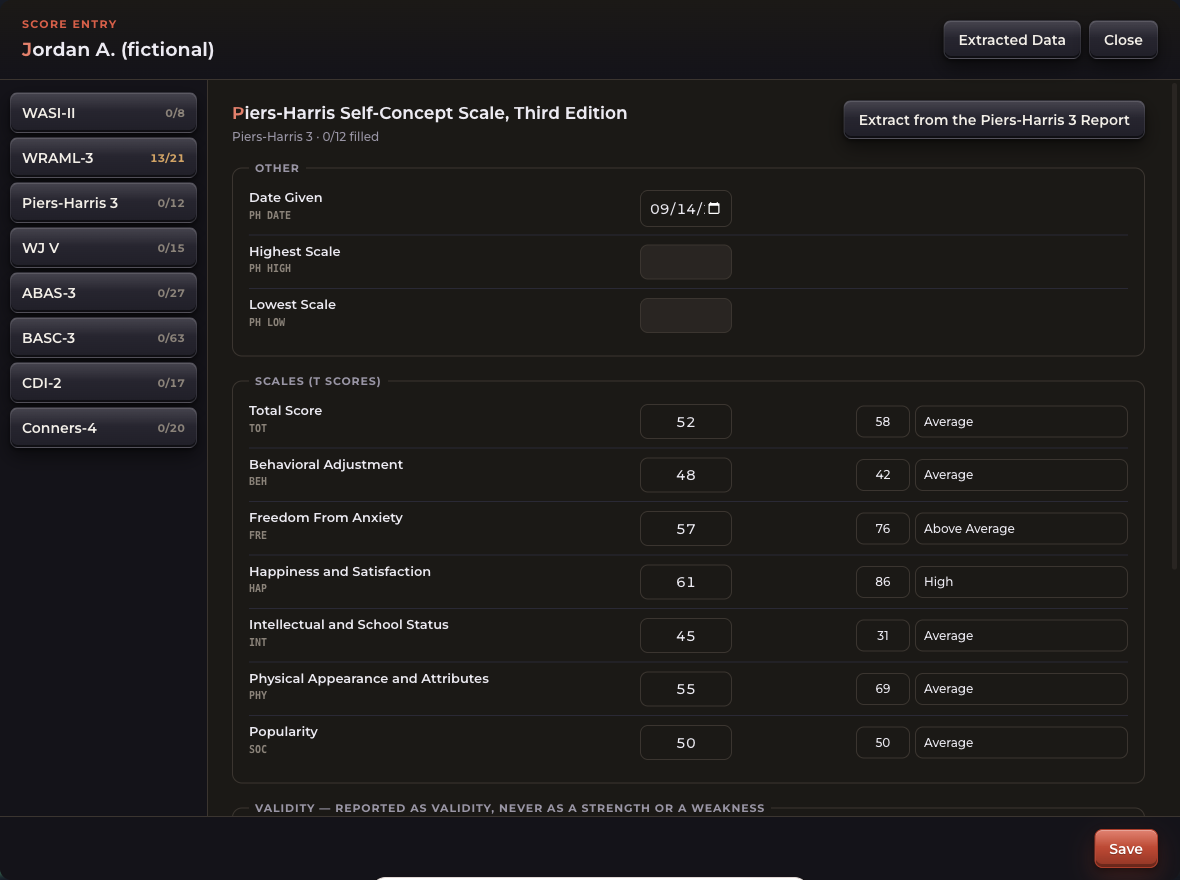
What the score card looks like
How AUTOMATA reads it
- Scales AUTOMATA reads: Total Score, Behavioral Adjustment, Freedom From Anxiety, Happiness and Satisfaction, Intellectual and School Status, Physical Appearance and Attributes, Popularity (Social Acceptance).
- Validity scores are reported as validity. They are never presented as a strength or a weakness.
- Reads the printed score report (PDF text layer, or a photo or scan of that printout).
- Checks the student name and birth date on the page against the case before anything is filled in.
- Leaves a box blank when a number cannot be read cleanly. It never guesses.
- Marks every number it read in green so you can check it against the page; a number you type over turns back into a typed score.
What stays with the psychologist
The psychologist reviews and approves every score. Nothing is written into a report until you approve it.
In plain English for families
This is how the student describes themselves. Their answers are not a diagnosis. They are a starting point for a conversation about how the student feels at school and with friends.
Questions
What do the validity scores do?
They flag random or biased answering. AUTOMATA shows them separately and never labels them a strength or weakness.
Is a low score a diagnosis?
No. It is the student's own view, to be read with other information.
Does it work with other rating scales?
Yes. It sits beside BASC-3, CDI 2 and Conners 4 results on the same case.
Related tests
Every new AUTOMATA user gets a free 1-week trial, no payment details.
Founding tester spots: 10 users get 60 days free, unlimited reports, no card. Just tell Dr. Valentine what works.
Start your free trialApply for a founding spotSee a sample reportThis page is a general summary for families and practitioners, not a substitute for the publisher's manual. Test names are trademarks of their publishers. AUTOMATA is not affiliated with or endorsed by any test publisher. No test items, stimuli or scoring keys appear on this page.